Very recent developments in Iraq are very bad, but there is probably a glimmer of hope in what news I've seen: the fact that Iraqis are stunned at the violence of the last few days probably means we won't see this continuously. There may be further outbreaks of this sort or worse, but hopefully they'll be infrequent.
I think now is the time to ask a tough question: at what point should we say Iraq has crossed the line from "sectarian violence" into "civil war"? What are the criteria that separate the two? On first reflection, a civil war seems to require (at least) two sides with competing claims to legitimate rule over a certain territory, but this seems unlikely in a time and place where the nation state looks very different than it did in (for example) 19th C America. Neither terrorist organizations nor fundamentalist Islamists--and I'm told there's an overlap there--seem to be interested in collecting taxes or providing police service. So let's come up with a broader definition of civil war, in order to fully reflect the violence of the situation if and when the time comes.
I propose this: we can call it a civil war when bombings and disruptions such as this are not resolved in any way before the next one occurs, so that the events run together enough to be considered one large event. To be more precise, this will occur when the period between major violent events is shorter than the news cycle. There will be at least two objections to this definition. First, that the length of a news cycle is undefined. I agree, but I don't mind leaving this as a subjective definition, open to reasonable interpretations. As a rule of thumb, let's remember that the Cheney shotgun story, which was drawn out longer than necessary because of a sloppy media strategy, lasted a little under a week. The second objection will be that this defines the term on the basis of our Western perception of events rather than that of the Iraqis, who would obviously be most affected by this hypothetical war. I don't really have a problem with this. The closer you get to the ground, the less it matters what you call it. If you die as a result of sectarian violence, you're just as dead as if you die in a civil war, and your family is just as devestated. It's only as you move away from the events that names become important. If we have a good idea what Civil War is, we'll have a better idea when to admit failure and change strategies.
That is, if anyone can think up something good.
Friday, February 24, 2006


Friday, February 10, 2006
Enough of that

One of my biggest disappointments was being to big to fit into Japanese clothing. My mother used to have a sweatshirt featuring the great Larry Biod, and I got nothing. Well, now my prayers are answered.
Thursday, February 09, 2006
What do you expect from a Yankees fan?
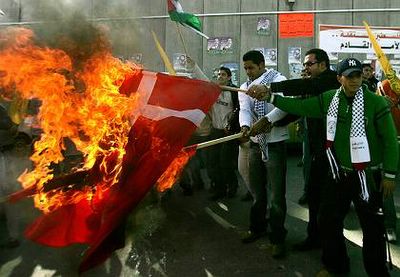
Muslim-baiting vs. violent fundamentalism? A pox on both your houses. Free speech is an important value, but sometimes silence is more honest. It's very hard to say anything in this matter without taking sides, and I don't want to do that.
But I'll say one thing: U.S. newspapers should run the cartoons now. They're legitimate news items. Not running them shows a lack of respect for the people of the Islamic world, since it assumes they can't tell news from racist provocation.
Click on the picture for smart commentary from Der Spiegel.
Friday, January 27, 2006
New Acquisitions
I was just going to pay rent and deposit my stipend check, but the used book stores sucked me in. It's an addiction, I swear.
Richard Farina, Been Down So Long It Looks Like Up To Me. So far I haven't gotten past Pynchon's intro; their Cornell seems to be a very different place than mine was.
Isaiah Berlin, The Crooked Timber of Humanity.
Janet Flanner, Paris Journal, 1944-1965. I love Paris Was Yesterday. This one's out of my period, but I'm sure it will be just as much fun.
Kobo Abe, The Woman in the Dunes. I'm told it's weirder than Murakami. I'm not a huge fan of Murakami, but weird is good.
Montaigne, Essays. It wasn't until I left the shop that I remembered I was planning on buying these in French.
Wednesday, January 25, 2006
Thursday, January 05, 2006
2006 in Bowl Games
The year of the failed lateral and the missed field goal. Just goes to show that failure is more interesting than success. The winners: all the losers.
New Pornographers
Music sounds different on the radio. Use It is way too complex rhythmically to work with anything less than complete attention and passable sound quality. Which makes me wonder why that's the one that's getting airplay. Sing me Spanish Techno!
Sunday, December 18, 2005
Not a top ten
Totally predictable list of music I didn't hate this year:
Architecture in Helsinki, In Case We Die. Along with Deerhoof, I think AiH is a great example of the resurgence of pop music. Challenging but catchy as all hell, both of them. Just goes to show that 69 Love Songs is the most important record of the decade, the way Nevermind and Loveless were for the 90's.
Bloc Party, Silent Alarm. Backlash-proof. Yeah it's another Gang of Four ripoff, but it sounds good, y'know?
Clap Your Hands Say Yeah. Yeah.
Edan, Beauty and the Beat. Yes I'm white. Why do you ask?
Feist "Mushaboom," Coralie Clement "Bye Bye Beauté," Keren Ann "Chelsea Burns." I'm not sure it's fair to lump these three together. I like them in very small doses, but these are all great songs convincingly performed. Fragile and soft is the new riot grrl.
Four Tet "Joy." Less beautiful than "My Angel Rocks Me Back and Forth. "
The Kills, No Wow. I didn't listen to this enough, but I have no doubt that it'll hold up, so I can still listen to it next year. Shows the Yeah Yeah Yeahs how it's done.
Metric, "Monster Hospital" and Ladytron, "Destroy Everything You Touch." The best political songs are the ones that don't get noticed as political songs. "When the President Talks to God" sucks. M.I.A. is still awesome, though. "Rich Man's War," by Steve Earle too.
Of Montreal, "The Party's Crashing Us Now." I have more songs and fewer albums on this list than I would have had last year, because have an iPod now. Put them in with AiH and Deerhoof as quirky pop.
New Pornographers "Bleeding Heart Show." I don't think the album's great, but this song is. Less pop than the first two albums. It seems like they're starting to take themselves seriously, which normally I'd say that's a bad thing, but here it works.
Nouvelle Vague, s/t. This is how songs get canonized. Right on the border between a novelty record and a standards album.
Stars, Set Yourself On Fire. "I am trying to say what I wanted to say without having to say I love you." What kind of self-respecing neurotic can't identify with that?
Sleater-Kinney, The Woods. Are they turning into hippies? I still like Call the Doctor and Dig Me Out more, but this is good. I'm imagining stoned teenagers in the seventies listening to Zeppelin and Deep Purple and saying "man, this just ROCKS," and now I know exactly what they meant. In those "music genome" projects that people are working on right now, do you suppose there's a category for how much something "rocks"? This one would be at 11, obviously.
Saturday, December 17, 2005
Oh, we know you're listening
Authors reading what bloggers have to say about them. "Seems narcissistic" indeed.
The mistake Ms. Paul (it's the Times, after all) makes is that we really care about people who write books. Lots of us are people who write books, or will one day write books. And still we don't care. We're just writing stuff to see ourselves in print.
The mistake Ms. Paul (it's the Times, after all) makes is that we really care about people who write books. Lots of us are people who write books, or will one day write books. And still we don't care. We're just writing stuff to see ourselves in print.
Monday, December 05, 2005
I'm cool, I swear!
Because I bought  Europe Central before it won. I didn't read it before it won, but that's because it's like a thousand pages long.
That counts, right?
 Europe Central before it won. I didn't read it before it won, but that's because it's like a thousand pages long.
That counts, right?
Monday, November 28, 2005
Never Let Me Go, by Kazuo Ishiguro
I had Thanksgiving dinner with a former president of Providence College, who now teaches one course, on contemporary ethical issues. We didn't have much of a conversation about any of those issues, partly because I don't know much about ethics and partly because he quickly derails any conversational give-and-take into a story. He's one of those older men who have an endless supply of stories to tell, and tell them fairly well, and jump at any slight excuse to tell them. The problem is the stories themselves aren't that great, and have to do mostly with law suits the college won, and students who come to class in baseball caps. John Heineman was like that too.
My point? None really, except that after reading Never Let Me Go last week, I've been thinking about contemporary ethical issues.
I'm not sure how much Ishiguro intended this novel to be part of the debate over cloning issues, and how much he simply wanted to write one of those poignant, frustrated love stories that he seems so fond of, which just happens to take place in a slightly alternate reality. The title is taken from a touching, intimate scene in the novel that has nothing to do with cloning at all, so it suggests that the balance is meant to be towards the latter. But remember that Remains of the Day used a seemingly apolitical love story to comment on democracy and fascism, themes which very rarely popped up explicitly, and bore very little of the plot's weight. Same here.
I don't mean to say that this is an anti-cloning novel, because despite the obvious inhumanity of the society depicted, it isn't. But it's not really a love story either. It's a story about how acceptable certain horrific injustices can feel. Ishiguro reveals the details of the cloning scheme slowly, which emphasizes the fact that none of this seems particularly shocking to the characters. It does to us, of course, but there is no preaching about the evils of cloning--to us, as they are to themselves, the characters are fully human and individual. The effect could just as well be to remind that there are real-world injustices which are nearly as horrifying, and which we block out the best we can.
The controlled, slow reveal has fooled some people into thinking of it as a mystery story, but there's really not much suspense. Unfortunately there is one of those climactic scenes in which all is revealed, a la Miss Marple, and in my opinion this is the least successful passage. But it's ambiguous and unsatisfying enough to not cheapen the experience of the book up to that point.
It's a bit to easy to find a "live life to the fullest" message for my taste. I know, it's probably good advice. But if I were living life to the fullest, I probably wouldn't have had time to read the novel, now would I?
My point? None really, except that after reading Never Let Me Go
last week, I've been thinking about contemporary ethical issues.I'm not sure how much Ishiguro intended this novel to be part of the debate over cloning issues, and how much he simply wanted to write one of those poignant, frustrated love stories that he seems so fond of, which just happens to take place in a slightly alternate reality. The title is taken from a touching, intimate scene in the novel that has nothing to do with cloning at all, so it suggests that the balance is meant to be towards the latter. But remember that Remains of the Day used a seemingly apolitical love story to comment on democracy and fascism, themes which very rarely popped up explicitly, and bore very little of the plot's weight. Same here.
I don't mean to say that this is an anti-cloning novel, because despite the obvious inhumanity of the society depicted, it isn't. But it's not really a love story either. It's a story about how acceptable certain horrific injustices can feel. Ishiguro reveals the details of the cloning scheme slowly, which emphasizes the fact that none of this seems particularly shocking to the characters. It does to us, of course, but there is no preaching about the evils of cloning--to us, as they are to themselves, the characters are fully human and individual. The effect could just as well be to remind that there are real-world injustices which are nearly as horrifying, and which we block out the best we can.
The controlled, slow reveal has fooled some people into thinking of it as a mystery story, but there's really not much suspense. Unfortunately there is one of those climactic scenes in which all is revealed, a la Miss Marple, and in my opinion this is the least successful passage. But it's ambiguous and unsatisfying enough to not cheapen the experience of the book up to that point.
It's a bit to easy to find a "live life to the fullest" message for my taste. I know, it's probably good advice. But if I were living life to the fullest, I probably wouldn't have had time to read the novel, now would I?
Sunday, November 20, 2005
Two hacks
In an attempt to put that embarrassing letter to Salon.com behind me (seriously, I need to work on my web presence) I responded to this here.
He blames the riots in France on socialism. I'm not sure if he knows whether or not the French government is not in fact socialist, not even in name. In fairness, I suspect that he might not have written the title of the piece, which is the only place in which he states (rather than implies) that Chirac is a socialist. I didn't write the title of my piece either, which was a mistake on my part, because it does a very bad job of explaining my point.
I wish I'd known about Timothy Smith's book before I wrote it. Smith's point is that as much assistance as the French government gives, it's not redistributive in an egalitarian way. So while the middle class gets great pensions, the banlieux get the CRS. More on this later.
He blames the riots in France on socialism. I'm not sure if he knows whether or not the French government is not in fact socialist, not even in name. In fairness, I suspect that he might not have written the title of the piece, which is the only place in which he states (rather than implies) that Chirac is a socialist. I didn't write the title of my piece either, which was a mistake on my part, because it does a very bad job of explaining my point.
I wish I'd known about Timothy Smith's book
before I wrote it. Smith's point is that as much assistance as the French government gives, it's not redistributive in an egalitarian way. So while the middle class gets great pensions, the banlieux get the CRS. More on this later.
Wait, high school students having sex is a bad thing?
George Will starts out this stupid stupid column by saying "let's be good cosmopolitans and offer sociological explanations rather than moral judgments..." and then offers up moral judgements in the guise of sociological explanations. Tricky.
A numbered list of the problems I have with the column:
1. He argues that having rules simply for the sake of having rules is a good thing, instead of a totally arbitrary constraint on entirely value-neutral forms of culture.
2. Turns out that one specific form of culture that is destroying politeness is black culture. How convenient for Will that he happens to be white and catholic and rich. Also, he puts scare-quotes around "street" and "gangsta" and "edgy." George, just because you have no idea what those concepts are doesn't mean the concepts don't exist.
3. Using the iPod as an explanation for any (non-musical) cultural trend is so two-years-ago. He needs to go read Steven Johnson.
I think the (supposed) decline of manners might have more to do with a growing realization that moralists like George Will are full of crap.
Saturday, October 15, 2005
The world is changing, man
This is kind of amazing:
I don't know what to say about it. Microfilm will be obsolete in 10 years. And there aren't going to be any collectors out there, like there are for vinyl. We can tell our children stories about how we used to use film where the writing was really really tiny...
-Wait, what's film?
-You know, like in a camera.
-What? Cameras don't have film.
-Shut up. The writing was really tiny but it was there, and there was a lens and it blew up the figures and projected them on a screen.
-You mean like a computer screen?
-No, just a flat sheet of plastic.
-Oh.
-It sucked. Your eyes got tired after looking at it for an hour or so. And we had to walk two miles through the snow to get to school. Uphill. Both ways.
-That's stupid. Gimme some ice cream.
Screw it, I'm not having kids. Little ingrates.
Monday, June 13, 2005
"What are they doing?"
That's what my boss asked me when I told her that I'm nerding out over EU politics. Short answer: France and Holland voted down their constitutional referenda, and now nobody has any idea what the hell is going to happen. But you knew that.
I tried to explain about delocalisation and Polish plumbers but that's not what I really care about. What I really care about is the related question of what this means for the project of constructing a post-national world. I would love for Europe to become the world's biggest NGO. Because it's a wild concept. Because I'm not a huge fan of nationalism anyway. And yes, because it will be the best way to avoid the dangers of hyper-puissance. Not just the US, but China too--Europe should be on the same side as the US on 90% of the issues.
The person who deserves most of the blame, I think, is Chirac. As I said, I agree with the idea of constructing a strong Europe, but I think it was a terrible mistake to connect this to Gaullism and gloire. There's a fundamental contradiction in what he asked France to do: on the one hand he appeals to nationalist sentiment, and on the other he wants to give up a certain amount of sovereignty. People were right to suspect that his vision of Europe had more to do with economic and military power than with social justice. If you want to create a Europe that can balance American power, you're not going to convince anyone by trying to turn it into a carbon copy of America. You have to trust that the European vision of society (i.e. "social") can hold its own against the American (liberal) and the Chinese (authoritarian-capitalist). Emphasize that nationalized health care is cheaper. Point out that European society is admirably egalitarian. That it isn't torturing people. Make it the beacon of hope and liberty that America used to be.
Why couldn't the Socialists make this case? Why couldn't they appeal to the great French tradition of exporting democracy and justice? The EU acts to inspire democracy in Ukraine, in the Balkans, in Turkey the same way the French Revolution did in Germany and Italy. And yet the Socialists turn away from enlightened internationalism. Very disappointing.
Sunday, February 13, 2005
Why France?
Apart from the question of "why fascism?" there is also the question of "why France?" And the answer cannot be simply because I know France, and French. This project is also in part an attempt--pointless to deny it--to offer the French experience of citizenship and nationalism as a model for the world. The tension in French citizenship between the national and the universal, which stems from the Revolution and the resulting habit of thinking of France as the cradle of democracy, obviously has its problems. It excuses a certain amount of belligerence, especially when it comes to the colonies and even ex-colonies. It causes a bit of self-righteousness, as with de Gaulle and Chirac, for example. But it is, I think, the best model we have for a national identity that has the necessary flexibility to survive globalization.
And French Fascism has this tension too. It was not simply nationalist, it was universal too. The problem was to create a French version of an incredibly popular international movement--because from their perspective (and they weren't far wrong) Fascism was a wave sweeping over Europe. So this was one step in the development of the French nationality.
And French Fascism has this tension too. It was not simply nationalist, it was universal too. The problem was to create a French version of an incredibly popular international movement--because from their perspective (and they weren't far wrong) Fascism was a wave sweeping over Europe. So this was one step in the development of the French nationality.
Thursday, February 03, 2005
Engineers are all evil
Henry at Crooked Timber defends us liberal humanists against the charge that Al Queda's ideology comes from supposed anti-Western nihilism in the academy. Turns out that most of their members are professionals; engineers and architects to be precise. Interesting in light of Herf's study of support of National Socialism among engineers.
Not that Al Queda and the Nazis have anything to do with each other. Except I suppose they both hate freedom.
My senior year in college I shared a house with 13 smart people. I was the only one in the humanities. The rest were mostly scientists and engineers. None of them are either fascist or terrorist, as far as I know.
Fascist membership
From where (geographically, class) did Fascist organizations draw their membership? Soucy (is it Soucy?) claims that they had little success luring workers away from the Socialists, but these people still lived in the city, no? Or the banlieu? This should be pretty straightforward, but it might be the first chapter. Go to Soucy to find where one can get membership records. Police reports? Did the ligues keep membership rolls, and have they survived? Has no one answered this question yet?
A more complicated question is whether they were recent arrivals, or had always lived there. Harder to determine.
If you want to claim there was an urban element to this, this is a simple way to do it.
A more complicated question is whether they were recent arrivals, or had always lived there. Harder to determine.
If you want to claim there was an urban element to this, this is a simple way to do it.
Why are we here?
What purpose to historians serve?
I mean apart from teaching history, which is a complicated and necessary task in itself, and involves various tasks. Entertaining. Passing on some kind of cultural legacy. Legitimizing certain forms of thought and expression. Ranking students on the basis of these forms of thinking.
But what good does the historian as researcher and writer serve? Is this an entirely selfish endeavor, whose only point is to allow us to surround oneself with the things in human history that we think are cool? A form of self-expression, the presumptuous presentation of one's own worldview as the truth?
No answer at the moment.
Subscribe to:
Posts (Atom)